
Why a book about Thomas Prence of Plymouth Colony?
One of my goals in writing this book is to allow us to think about what life in Plymouth Colony would have been like during the first fifty years (minus one) as experienced by the people who lived there. The story of the English citizens who first migrated to Leiden, Holland seeking a Church more true to God’s plan, who arranged for a second migration to North America to establish a colony where they could continue their faith journey in a less distracted environment, who made that journey on the Mayflower during 1620, where one-half of them died during the first year leading up to the First Thanksgiving, has been told many, many times. So, I see no need to retell the story up through November 1621 through the eyes of a member of the Leiden Church. I do not believe the story of the Plymouth Colony has yet been told in the eyes of a non-member of the Leiden Church, beginning with the arrival of the Fortune and continuing through until the fiftieth anniversary of the colony. This is the story of the Plymouth Colony presented “in the form of a story” and “from the perspective” of a person “who lived that story” while not feeling the need for the story’s ending to justify the origin of the story. I have elected to use the genre of biographical fiction for telling this story.
Over the years, I thought about what it might have been like living in Plymouth Colony. I have many ancestors [through three of my grandparents] who were enumerated in the 1627 Division of Cattle which serves as the census of the 156 men, women, and children who were living in Plymouth in 1627. So I have had plenty of folks from whom to dream up stories about, including wondering about which ones would have had interactions with which others. For many years, I was somewhat fixated on how I might create a story which would involve as many of my Mayflower passenger ancestors as possible. When one thinks about it, if you have ancestors from multiple Mayflower passenger families, just about everyone in the colony would have interacted with those in the other families, since there were only fifty-two individuals who survived the first winter. Thus, the thought of how many of one’s Mayflower ancestors knew one another becomes almost a silly question. A better question might be “how many of them liked one another?”
But back to my original thought. If I was to prepare a biography of a single resident of Plymouth Colony, from whom to gain an appreciation of what was happening in the colony, over as long a period of the colony’s development and growth as possible, who might that person have been. I decided to limit my candidates to those persons who were considered an “Oldcomer” – or a passenger on the Mayflower or the Fortune or the Anne who arrived in Plymouth by July 1623 – at a minimum age of say eighteen. I next decided to limit my candidates to those persons who remained in Plymouth for a minimum of fifty years, for example they might have been in attendance at a Fiftieth Anniversary Celebration for the Colony. My final criteria was for my candidates to have been one of the men who would have been considered by a wide spectrum of the community to have been one of the leaders within the colony. For this criteria, I limited my candidates to have been elected to colony-wide office [Governor, Assistant, Treasurer] on a regular basis during the first fifty years of the colony. Further, I limited my candidates to being one of the eight “Undertakers “who by 1627 had assumed responsibility for paying off all of the debts which had been incurred during the founding of the Colony. Keeping in mind that they did not make the final payment until 1645 at which time those who remained sold off some of their personal property [homes, farms, and vacant land] to raise the money.
Isaac Allerton of the Mayflower left the colony in disgrace by 1635, going first to the Massachusetts Bay Colony, later to the Dutch colony of New Amsterdam and finally to New Haven where he died in February 1658/9; Elder William Brewster of the Mayflower was the religious leader of the community, although he died in Duxbury in April 1644; Governor Edward Winslow of the Mayflower left the colony returning to England in 1646, and died in May 1655; Captain Myles Standish of the Mayflower died in Duxbury in October 1656; and Governor William Bradford of the Mayflower died in Plymouth in May 1657. By eliminating these five men from consideration based on the fact that two of them had left the colony by 1645, and the three others had died by 1657, we have also eliminated all of the candidates whom had roots with the Leiden Church [Myles Standish was only loosely affiliated with the Leiden Church whereas the other four were members of the Leiden Church]. The initial struggle by the Church to control community leadership during the initial ten years was successful, although simply by attrition gradually faded away due to the combination of death of Leiden Church leaders and dilution by arrival of new residents to the community.
Our criterion of still being alive and active in the community through November 1670, leaves only three men meeting all three of our criteria – John Howland, John Alden, and Thomas Prence. None of these three early Plymouth Colony leaders were leaders within the Leiden Church movement. John Howland of the Mayflower was one of the Undertakers, he was elected as an Assistant three times between 1631 and 1635, although he was elected nineteen times as a Deputy from Plymouth to the General Court he was never again elected to Colony-wide office, and he died in Plymouth in February 1672/3. As will be seen below, the two remaining candidates who meet all three criteria both have a much stronger resume with regard to public service and overwhelming respect by the freemen of the colony over the entire initial fifty years of the colony’s existence.
Neither of our final two candidates, John Alden and Thomas Prence, were associated in any manner with the Leiden Church, although it is believed that both of them were early conformers to the Leiden Church’s expectations with regard to worship and lifestyle. John Alden was recruited for the Mayflower voyage to serve as the ship’s cooper, a position required by English maritime regulations with the purpose to keep all of the food and beverage [being stored in barrels, kegs and casks] properly contained and sanitary. Alden had no connection with the Leiden Church, nor its members who were planning the voyage and if he had any connections prior to the voyage, they would have been with either the Adventurers or the ship’s master or captain. John Alden was elected, by the freemen of the colony, as an Assistant in forty-five years out of fifty-five years prior to his death. In most years he was not elected as an Assistant, he was elected as a Deputy from Duxbury to the General Court. It would seem that the fact that John Alden rose to a position of such prominence within the Plymouth Colony likely had much to do with his natural abilities combined with willingness to conform to the expectations of the community. Alden died in Duxbury in September 1687, being the last surviving of the Undertakers.
Governor Thomas Prence of the Fortune died in March 1673 and was one of the Undertakers. Thomas Prence was elected as Governor twice between 1633/4 and 1637/8 and sixteen times between 1657 and 1673. Other than William Bradford [thirty-one years as governor], Edward Winslow [three years as governor], and John Carver [less than one year as governor], only Thomas Prence [who served eighteen years as governor] served as a governor of the Plymouth Colony during its first fifty years. Between 1633 and Governor Bradford’s death in 1657, in addition to the two times in which Prence was elected governor, he was elected as an Assistant in each and every election. While the records do not remain, it is likely Prence served as an Assistant in some of the years between 1627 and 1633 while Bradford was governor. Further, Thomas Prence was elected fourteen times as a Commissioner from Plymouth Colony to the United Colonies of New England [including serving twice as President]. Thus, a review of the records of the Plymouth Colony shows that no man ever served as a leader within the Plymouth Colony at the same level, nor over such a sustained duration as did Thomas Prence. While William Bradford served as governor for more years than did Thomas Prence, he did not live to experience the Plymouth Colony during the years beyond 1657. Similar to John Alden, It would seem that Thomas Prence rose to a position of such prominence within the Plymouth Colony likely due to his natural abilities and leadership skills, combined with a willingness to conform to the expectations of the community.
When considering the responsibilities of an Undertaker between 1627 and 1645, as well as the responsibilities of serving on the General Court [being either an Assistant or Governor of the colony] between 1631 and 1671, there is only one conclusion – no one likely knew the Plymouth Colony or its residents, between November 1621 and November 1671, as well as did Thomas Prence. In some regards, it is quite remarkable that one of the men whom William Bradford had stereotyped as “lusty young men and many of them wild enough” and whom was not at all affiliated with the Leiden Church movement prior to his arrival in Plymouth, would have risen to the top rung of Plymouth Colony society so quickly and remained at the top for fifty years. In addition to the support of the freemen of the colony over all of these years, William Bradford, in his noncupative will, identified his faith and trust in Thomas Prence’s judgement when he stated he had “deferred the forming on his will in hopes of having the help of Mr. Thomas Prence,” and then Bradford appointed “my well-beloved Christian friends Mr. Thomas Prence, Captain Thomas Willett and Lieutenant Thomas Southworth” as the supervisors of his estate [Thomas Southworth was one of Bradford’s stepsons, Thomas Willett had served as an Assistant under Bradford between 1651 and Bradford’s death, and Thomas Prence had been Bradford’s protege for thirty years].
Without giving away the storyline of the book, it should not be much of a surprise that some of Thomas Prence’s closest friends, supporters, and trusted allies would have been Jonathan Brewster [Fortune passenger], Love Brewster [Mayflower passenger], Elder William Brewster [Mayflower passenger], John Winslow [Fortune passenger, died in March 1673/4], John Alden [Mayflower passenger, died in September 1687], John Howland [Mayflower passenger, died in February 1672/3], and William Collier [arrived in Plymouth in June 1633, died in May 1670].
Why the title?
When thinking about the theme for this book – as well as to be presented “as a story” and “from the perspective” of a person “who lived that story” – it just seemed like “Thomas Prence’s Plymouth Colony” summarized it well. It is both a biography of Thomas Prence’s life as well as Thomas Prence’s perspective of many of the important events which occurred in Plymouth Colony between November 1621 and March 1673. In many of the defining roles during his lifetime – Fortune passenger, Undertaker, Assistant, Governor, Commissioner, President, husband to four wives, father to nine children [eight daughters who married and brought forth many grandchildren], step-father to four children, uncle to forty-seven nieces and nephews – Thomas Prence had relationships of all sorts with a very large number of Plymouth Colony residents over a fifty year period. For fifty years, Thomas Prence had lived in a close and personal manner, along with the others who made the most difficult decisions regarding the life of the colony, through the stress and agony involved in making such difficult decisions. And, yes for fifty years, from his unique perspective, this was “Thomas Prence’s Plymouth Colony“.
A work of “Biographical Fiction”
I had spent years working on finding all of the necessary documentation for how I am connected, generation upon generation, to Mayflower passengers. I had successfully completed seven applications which were accepted by The Mayflower Society as a descendant of Elder William Brewster [including his wife Mary Brewster], Stephen Hopkins [including his wife, Elizabeth Hopkins, and daughter, Constance Hopkins], Richard Warren, Francis Cooke, John Tilley [including his wife, Joan Tilley, and daughter, Elizabeth Tilley], John Howland, and Edward Fuller [including his wife, name unknown, and son, Samuel Fuller]. These seven men [who signed the Mayflower Compact] along with four of their wives and three of their children are my direct ancestors. Nine others in their immediate families, including son Love Brewster, son Wrestling Brewster, son Giles Hopkins, daughter Damaris Hopkins, infant son Oceanus Hopkins [born onboard the Mayflower], son John Cooke, and brother Edward Tilley [along with his wife Agnes Tilley], brother Samuel Fuller also made the voyage on the Mayflower. But, it was not just about the challenge of filling out lineage papers and finding the required proof of each link along the chain. It was about learning as much as possible about them and their families during the founding and establishment of a new colony. In addition to these twenty-three passengers on the Mayflower, a number of them died during the first sickness, it is also important to include the eleven members of their families who arrived three years after the Mayflower, on the Anne. They were daughter Patience Brewster, daughter Fear Brewster, wife Elizabeth Warren, daughter Mary Warren, daughter Ann Warren, daughter Sarah Warren, daughter Elizabeth Warren, daughter Abigail Warren, wife Hester Cooke, daughter Jane Cooke, and son Jacob Cooke. Further, in order to better understand these people living as families in a community, we need to add the others who traveled with them as extended family, wards, and servants. In the above case, this includes fourteen others being Richard More and Mary More [wards of the Brewster family], Edward Doty and Edward Lester [servants of the Hopkins], Henry Samson and Humility Cooper [wards of the Tilley family], while John Howland had travelled with the Carver family group consisting of John Carver, Katherine Carver, Desire Minter, Roger Wilder, William Latham, Jasper More, and Dorothy ——]. This brings the total number of folks travelling together on the Mayflower and Anne from my seven patriarchs [William Brewster, Stephen Hopkins, Richard Warren, Francis Cooke, John Tilley, John Howland, and Edward Fuller] up to a total of forty-eight passengers. Now it becomes much easier to view these seven names as a a significant portion of a small community.
Those names which are in bold underline are those Mayflower passenger direct ancestors where applications have been approved by GSMD. Names in bold italic underline are those Mayflower passenger direct ancestors who are identified on an approved application. Names in bold italics are immediate family members who were Mayflower passengers. Names in red bold italic underline are Anne passenger direct ancestors. Names in red bold italics are immediate family members who were Anne passengers.
I have also done research on Thomas Prence over many years. Thomas Prence is one of my direct ancestors who arrived in Plymouth on the Fortune in 1621. Prence left London alone in June 1621, although he was likely a very close friend of Jonathan Brewster and John Winslow, and also a friend of Robert Cushman [and his son Thomas], William Bassett, Philip Delano, and Moses Simonson] by the time they arrived in Plymouth in November 1621. Thomas Prence’s first wife, and also one of my direct ancestors, was Patience Brewster. Patience arrived on the Anne in 1623 and her parents, William and Mary Brewster, had arrived in Plymouth on the Mayflower in 1620. Thomas Prence’s father-in-law was Elder Brewster, one of the organizers of the Mayflower voyage and the religious leader of the colony until his death in 1644. Prence and Brewster had a close relationship, with Brewster being Prence’s surrogate father in Plymouth. Thomas Prence’s second wife, and also one of my direct ancestors, was Mary Collier. Mary arrived on the Mary & Jane in 1633, along with her parents, William and Jane Collier, and her four sisters [Rebecca, Sarah, Elizabeth, and Ruth]. Thomas Prence’s second father-in-law was William Collier, who had been one of the Adventurer’s who originally funded the Mayflower voyage and in 1627 exchanged his stock in the company for the future right to land in Plymouth as a Purchaser. Prence and Collier had a close relationship, being compatriots in the politics and governance of the colony.
My interest in family history began as a boy as an offshoot from my interest in American history. I was not much for memorizing names, places, and dates. I simply enjoyed reading about the people, places, and events. And more important for me was to begin to appreciate the continuum of history. Early on, I began to want to feel how having lived through certain events influenced people as they moved into the here and now of subsequent events. Then, it seemed to me that events which had strongly influenced people’s lives became those which were passed along to their children and grandchildren in stories within a family.
While I am working on my writing project I felt that I needed to think of him as more of someone that I gotten to know. I know of my own two grandfathers only in photographs as they both died before my birth, but I can visualize a face when I think of them and stories which I heard about them from my parents. As I am sitting around trying to recreate the lifetime experienced by Thomas Prence, I have found myself sitting and thinking about the facts and figures trying to attempt to create a logical story of his life.
Some thoughts about the book jacket
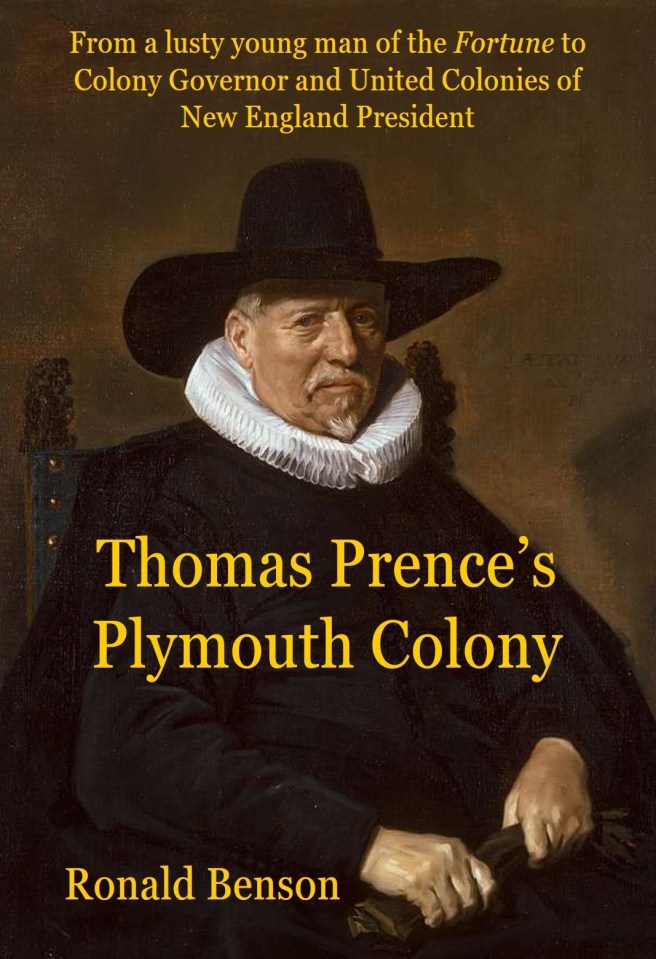
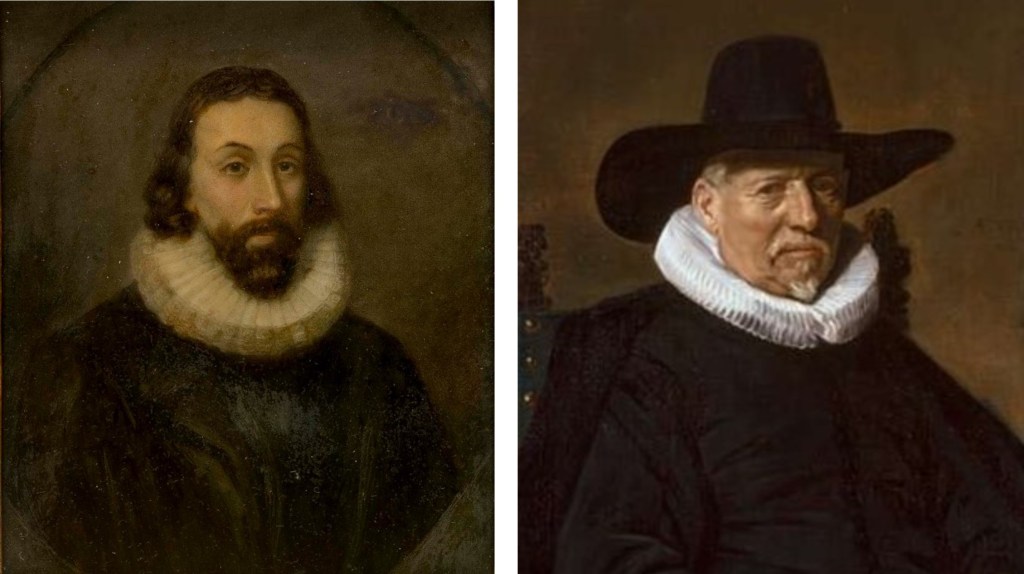
I know of no extant portrait of Governor Thomas Prence of the Plymouth Colony which might have been potentially used on a book jacket. My concept for a book jacket was to include a portrait of Thomas Prence to provide him with a visual image with the dignity similar to the famous portrait of Governor John Winthrop of the neighboring colony of Massachusetts. Therefore, since no known image of Thomas Prence had been found, I conducted a search for a potential portrait to be used as a surrogate. My thought being that if no one knows what Thomas Prence looked like as a man in his seventies [he died at age 73 in March 1673], then I could provide an image of what he might have looked like and how he likely would have dressed for multiple sittings for a portrait. Beginning with the portrait of Winthrop, I knew how a man of this dignity would have dressed – a dark suit of clothes with maybe a dark cape draped across him wearing a white ruffled collar. Also referring to the Winthrop portrait, I thought about hair style and facial hair. As it was a much younger Winthrop who sat for the example portrait, the longer style brown curly hair and fuller, groomed beard wouldn’t be expected for a man in his seventies. After some thought, I figured that an older distinguished gentleman may have been balding and worn his thinning hair shorter [wearing a wig when seated before the General Court] as well as also worn his facial hair trimmed. I read some online articles about how to recreate a set of clothes to wear today if wishing to fit in with our Pilgrim ancestors who lived in Plymouth. The recommendation was to consider either a large loose collar for casual or a ruffled collar for more formal, black suit of clothes for men for more formal, and you can’t go wrong with a large black hat [although it was recommended to stay away from the stereotype of large hat bands and buckles].
After spending a good bit of time on the internet looking at images of portraits of seventeenth century gentlemen, I started to get an impression of what sort of portrait I was looking for. I wanted something which was definitely painted during the proper period, but I wanted a portrait painted by one of the more talented portrait artists of the day such that the facial features would be of the caliber of what we are used to in modern portraits. I wanted to be able to see an expression on his face and look into his eyes. I figured that since I was using a surrogate model to “sit for my portrait” that I might as well put in my order for what I wanted. I found a series of portraits which had been painted during the mid-seventeenth century by the Dutch portrait artist named Frans Hals which I really caught my attention and which I felt to be what I had in mind. One potential portrait which was painted in 1643 caught my particular interest. The clothes and hat which were worn by the gentleman sitting for the portrait appear to fit the style and the period for which I was looking. After I thought about this longer, it seemed to make sense to me that if Thomas Prence had sat for a life defining portrait toward the end of his lifetime, he may have even purchased a new suit, ruffled collar, and hat for the portrait sittings. Further, in the mid-17th century it may not have been uncommon for a wealthy gentleman to have luxury items, such as a suite, collar and hat to have been imported into the Plymouth Colony from New Netherland [Dutch colony until 1664] which became New York [English colony after 1664].
Some links to work in progress related to the book project
 Born in Michigan... Made in America since 1620